Even funnier thing to imagine: resurrecting Diogenes too and telling him that “Platonic” relationships means not fucking, he’d probably laugh himself back to death.
So I actually know the origin of this term because it came up when I studied Plato in my classes. Basically, in ancient Greece it was a super common practice for teachers to fuck their students. Like all the time. It was considered a way for the student to “pay” the teacher. Plato thought this was bullshit. He felt that a student could not properly learn from someone who was truly only interested in having sex with them. He didn’t fuck his students and derided those who did. Other teachers who refused to fuck their students were said to have “platonic” teaching relationships with them – so named because they were following Plato’s example. So the reason it’s called a Platonic relationship is because Plato was heavily anti-teachers-fucking-their-students and it’s one of the few things he was ever even remotely correct about.
i’m not kidding and i’m not being mean i’m watching these videos of people trying to cut like, carrots, and they’re using butcher knives, and i just… I cook a lot and I don’t own a butcher knife, I’ve never had one, I’ve never needed one. I don’t cleave through… bone like. please
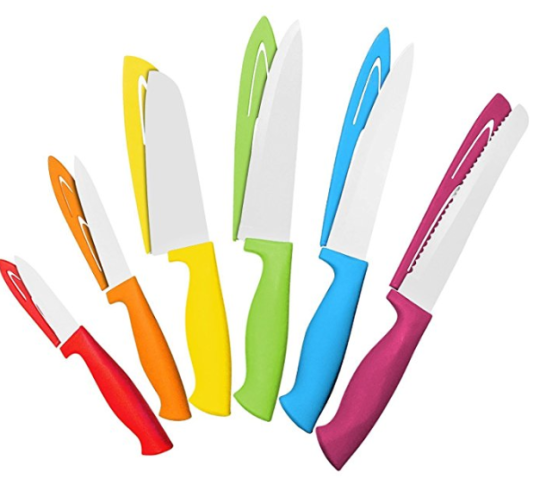
paring knife: it’s good for small cuts. deseeding a jalapeno, cutting up strawberries.
utility knife: allegedly these make cutting tomatoes easier. i don’t actually find cutting tomatoes difficult, so i don’t know. i use it mostly for trimming meat.
santoku knife: this is essentially a chef’s knife with a straight blade. it’s good for veggies.
chef’s knife: i use a chef’s knife for almost everything. it can chop a head of romaine and it can cut a chicken breast in half. whatever. just don’t use it for tiny shit.
slicing knife: good for slicing cooked meats
bread knife: bread
it’s also gay.
and here’s a cutting board with a knife sharpener. keeping your knives sharp is a good idea because cuts from dull knives are harder to treat, are more likely to get infected, and are more painful over time. cuts happen but you can reduce your risks
Who wants to get me some knives?
Gay knives save lives
we really getting sponsored posts for knives now huh
Also, please use sharp knives. If you cut yourself worth a sharp knife, it’s a clean cut and easy to take care of. If you cut yourself with a dull knife, it tears your skin, leaving you more at risk for infection and increases the need for stitches.
As it turns out, this is more like a halfway house. Prisoners usually begin their term in a prison more like one we’d typically recognize – bars on the windows, locked in their cells. But the emphasis there is on successful reintegration into society.
As their sentence progresses, with good behavior, they can move into a facility more like this, where their freedoms are still restricted, but they can do things like network with people outside of prison, search for employment, cook and clean and look after themselves, and begin making plans for their reintegration into society.
As a result, Norway has one of the lowest rates of recidisvism. 20% as opposed to America’s 76%.
It seems like a shocking idea to us because of where and how we live, but apparently, Norwegians are addressing the real problem. When you take people who can’t function well in society, and then…help them do that?…they….do. Without the crime-ing.
Turns out treating people like human beings makes them more likely to act like human beings….
But won’t that incentivize some people to go back there since they get treated so well and get a nice room versus the streets?
If you read the post above, it says Norway’s recidivism rate – that is, the rate of released criminals who go on to be arrested again – is 20% versus 76% in the United States, so for the most part, no.
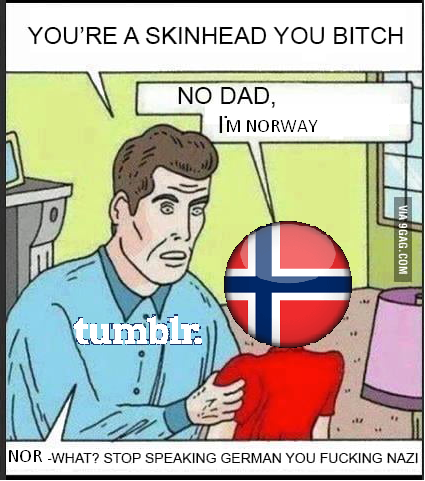
Isn’t that white-lined black cross on a red field flag a Nazi flag? Are we going to talk about how wonderful it is a Nazi gets a nice halfway house?
I have a lot of pet peeves but I think the biggest one is when people say things like “oh it’s such a small town, only 35,000 people” like bitch my town has 200 people, you need to pick a new adjective
According to Wikipedia, a small town is 1,000-20,000 people. So although you are correct in stating that 35,000 people is not a small town (it is a large town), you are incorrect in thinking that you live in a town. You live in a village. You are a villager.
I…… don’t know what to do with that information……a villager…
tag yourself with your living place’s population and what youre classified as. im 278,508 city boy
I have asked this myself in the past and never gotten an answer.
Maybe today will be the day we are both finally enlightened.
woodsgotweird said: man i just jumped on the bandwagon because i am a sheep. i have no idea where it came from and i ask myself this question all the time
Maybe someone made a typo and it just got out of hand?
I kinda feel like panic!at the disco started the whole exclamation point thing and then it caught on around the internet, but maybe they got it from somewhere else, IDK.
The world may never know…
Maybe it’s something mathematical?
I’ve been in fandom since *about* when Panic! formed and the adjective!character thing was already going strong, pretty sure it predates them.
It’s a way of referring to particular variations of (usually) a character — dark!Will, junkie!Sherlock, et cetera. I have suspected for a while that it originated from some archive system that didn’t accommodate spaces in its tags, so to make common interpretations/versions of the characters searchable, people started jamming the words together with an infix.
(Lately I’ve seen people use the ! notation when the suffix isn’t the full name, but is actually the second part of a common fandom portmanteau. This bothers me a lot but it happens, so it’s worth being aware of.)
“Bang paths” (! is called a “bang"when not used for emphasis) were the first addressing scheme for email, before modern automatic routing was set up. If you wanted to write a mail to the Steve here in Engineering, you just wrote “Steve” in the to: field and the computer sent it to the local account named Steve. But if it was Steve over in the physics department you wrote it to phys!Steve; the computer sent it to the “phys” computer, which sent it in turn to the Steve account. To get Steve in the Art department over at NYU, you wrote NYU!art!Steve- your computer sends it to the NYU gateway computer sends it to the “art” computer sends it to the Steve account. Etc. (“Bang"s were just chosen because they were on the keyboard, not too visually noisy, and not used for a huge lot already).
It became pretty standard jargon, as I understand, to disambiguate when writing to other humans. First phys!Steve vs the Steve right next to you, just like you were taking to the machine, then getting looser (as jargon does) to reference, say, bearded!Steve vs bald!Steve.
So I’m guessing alternate character version tags probably came from that.
100% born of bang paths. fandom has be floating around on the internet for six seconds longer than there has been an internet so early users just used the jargon associated with the medium and since it’s a handy shorthand, we keep it.
Absolutely from the bang paths–saw people using them in early online fandom back in 1993 for referring to things.
I had been doing it for a very, very long time but never actually knew the actual name for it. This is exciting! I like learning things.
I figured out a simple guide to the alignment chart last night
Lawful: Rules matter more to me than individuals. Chaotic: Individuals matter more to me than rules.
Good: Other people’s well-being is more important than my own. Evil: My own well-being is more important than other people’s.
Neutrals: My opinion of what is more important is determined on a case-by-case basis.
So a Lawful Good character’s guiding moral philosophy might be “I follow the rules because the rules keep people safe, even if they are sometimes inconvenient or harmful to me or other individuals.” A Chaotic Evil character’s guiding moral philosophy would be like “Screw the rules and screw you.”
This is a very succint way of explaining a long post from a few months ago. It is also kind of how it was originally written, and is what I use. No more “Is he chaotic neutral or chaotic evil” questions.



 tumblr backup