it’s hilarious to me when people call historical fashions that men hated oppressive
like in BuzzFeed’s Women Wear Hoop Skirts For A Day While Being Exaggeratedly Bad At Doing Everything In Them video, one woman comments that she’s being “oppressed by the patriarchy.” if you’ve read anything Victorian man ever said about hoop skirts, you know that’s pretty much the exact opposite of the truth
thing is, hoop skirts evolved as liberating garment for women. before them, to achieve roughly conical skirt fullness, they had to wear many layers of petticoats (some stiffened with horsehair braid or other kinds of cord). the cage crinoline made their outfits instantly lighter and easier to move in
it also enabled skirts to get waaaaay bigger. and, as you see in the late 1860s, 1870s, and mid-late 1880s, to take on even less natural shapes. we jokingly call bustles fake butts, but trust me- nobody saw them that way. it was just skirts doing weird, exciting Skirt Things that women had tons of fun with
men, obviously, loathed the whole affair
(1864)
(1850s. gods, if only crinolines were huge enough to keep men from getting too close)
(no date given, but also, this is 100% impossible)
(also undated, but the ruffles make me think 1850s)
it was also something that women of all social classes- maids and society ladies, enslaved women and free women of color -all wore at one point or another. interesting bit of unexpected equalization there
and when bustles came in, guess what? men hated those, too
(1880s)
(probably also 1880s? the ladies are being compared to beetles and snails. in case that was unclear)
(1870s, I think? the bustle itself looks early 1870s but the tight fit of the actual gown looks later)
hoops and bustles weren’t tools of the patriarchy. they were items 1 and 2 on the 19th century’s “Fashion Trends Women Love That Men Hate” lists, with bonus built-in personal space enforcement
Gonna add something as someone who’s worn a lot of period stuff for theatre:
The reason you suck at doing things in a hoop skirt is because you’re not used to doing things in a hoop skirt.
The first time I got in a Colonial-aristocracy dress I felt like I couldn’t breathe. The construction didn’t actually allow me to raise my arms all the way over my head (yes, that’s period-accurate). We had one dresser to every two women, because the only things we could put on ourselves were our tights, shifts, and first crinoline. Someone else had to lace our corsets, slip on our extra crinolines, hold our arms to balance us while a second person actually put the dresses on us like we were dolls, and do up our shoes–which we could not put on ourselves because we needed to be able to balance when the dress went on. My entire costume was almost 40 pounds (I should mention here that many of the dresses were made entirely of upholstery fabric), and I actually did not have the biggest dress in the show.
We wore our costumes for two weeks of rehearsal, which is quite a lot in university theatre. The first night we were all in dress, most of the ladies went propless because we were holding up our skirts to try and get a feel for both balance and where our feet were in comparison to where it looked like they should be. I actually fell off the stage.
By opening night? We were square-dancing in the damn things. We had one scene where our leading man needed to whistle, but he didn’t know how and I was the only one in the cast loud enough to be heard whistling from under the stage, so I was also commando-crawling underneath him at full speed trying to match his stage position–while still in the dress. And petticoats. And corset. Someone took my shoes off for that scene so I could use my toes to propel myself and I laid on a sheet so I wouldn’t get the dress dirty, but that was it–I was going full Solid Snake in a space about 18″ high, wearing a dress that covered me from collarbones to floor and weighed as much as a five-year-old child. And it worked beautifully.
These women knew how to wear these clothes. It’s a lot less “restrictive” when it’s old hat.
I have worn hoop skirts a lot, especially in summer. I still wear hoop skirts if I’m going to be at an event where I will probably be under stage lights. (For example, Vampire Ball.)
I can ride public transportation while wearing them. I can take a taxi while wearing them. I can go on rides at Disneyland while wearing them. Because I’ve practiced wearing them and twisting the rigid-but-flexible skirt bones so I can sit on them and not buffet other people with my skirts.
Hoop skirts are awesome.
Hoop skirts are also air conditioning. If you ever go to reenactments in the South, particularly in summer, you’ll notice a lot of ladies gently swaying in their big 1860s skirts – because it fans all the sweaty bits. You’ll be much cooler in a polished cotton gown with full sleeves, ruffles, and hoopskirt than in a riding jacket and trousers, let me promise you! (This is part of the reason many enslaved women also enthusiastically preferred larger skirts – they had more to do than sit in the shade, but they’d get a bit of a breeze from the hoops’ movement as they were walking.)
They’re also – and I can’t emphasize enough how important this is – really easy to pee in. If you’re in split-crotch drawers (which, until at least the 1890s, you were), you can take an easy promenade a few feet away from the gents and then squat down and pee in pretty much total privacy. It gives so much freedom in travel when it’s not a problem to pee most anywhere.
People also don’t realize that corsets themselves were a HUGE HUGE IMPROVEMENT over previous support-garment styles – and if you have large breasts that don’t naturally float freely above your ribcage (which some people’s do! but it’s not that common), corsets are often an improvement over modern bras.
They hold up the breasts from underneath, taking the weight of them off your back. Most historical corset styles don’t have shoulder straps, so you’re not bearing the weight of your breast there, either, and you can raise your arms as far as your dress’s shoulder line allows (which is the actually restrictive bit – in my 1830s dress, literally all I can do is work in my lap, but in my 1890s dress I can paddle a kayak or draw a longbow with no trouble. Both in a full corset). They support your back and reduce the physical effort it takes to not slouch, helping avoid back pain. They’re rigid enough that you don’t usually have to adjust your clothing to keep it where it belongs. They’re flexible – if you’re having a bloaty PMS day you just … don’t lace it as tightly, and if your back muscles are sore you can lace it a little tighter. And you can undo a cup (or, y’know, not have breast cups) to nurse a baby without losing any of the structural integrity of the garment.
I do educational/historical dressing and people are really insistent, like, “The corset was invented by a man, wasn’t it?” “Actually, women were at the forefront of changing undergarment styles throughout the 19th century!” “But it’s true that it was invented by a man.”
Uh, well, it’s hard to say who “invented” the style but it’s very likely that women’s dressmakers mostly innovated women’s corsets and men’s tailors mostly innovated men’s corsets, honey. Because those exist too.
Also? These fashions are about taking up space. They’re about being loud and visible and saying HERE I AM. About saying “I’m so rich, I need someone to help me dress every morning.” And about saying, “I am not solely here for male consumption”–there’s a reason so many cartoons lampooning women’s fashion are about how hard those ladies are to kiss, and how impossible it’d be to have a quick fuck in them. (Which it actually isn’t, but that’s beside the point)
Historical women’s fashions aren’t 100% unproblematic and absolutely wonderful. They make stark class distinctions incredibly visible, because you simply cannot wear some of these dresses and keep them maintained without a private staff to do a ton of work for you. They upheld a standard of femininity a lot of women were excluded from. They limited women’s and girls’ participation in sports and athletics.
Some people threw white paint on it a few years back.
They want to be a victim so bad.
Fun Fact: That’s a statue of the fist which Joe Louis used to knock out Max Schmeling, Hitler’s favored heavyweight boxer in 1938. Schmeling won the 1st bout by knockout in round twelve, but Joe Louis came back in the follow-up match and laid him the fuck out in the 1st round.
Fun Fact: Schmeling was hated by the Nazis for losing to a black man and for having a Jewish manager, and he hated them right back, stating in 1975 that he was glad he’d lost the fight because the thought of the Nazis using him for propaganda purposes sickened him. He also personally saved the lives of two Jewish children and later became lifelong friends with Joe Louis.
So maybe don’t refer to him as “Hitler’s favored heavyweight boxer”…
Thank you for this additional info!
Reblogging this for the added facts and so people know that Schmeling wasn’t a Nazi or Nazi collaborator and was in fact a good man
Imagine hating Nazis so much that when you get beaten up your response is “Good, now they can’t use me as a role model.”
i just remembered this story my dad told me one time, about abraham lincoln
a guy challenged abe to a duel once. lincoln very much did not want to duel this cat.
so lincoln agreed, on the condition he got to choose the weapon. maybe that was how it generally went in 19th century dueling culture, i have no idea.
the guy said “sure”
lincoln said, “ok. broadswords.”
so that poor would-be opponent shows up on the day of the would-be duel, and abe is outside, doing, like, some quick sword warmups.
now, back in lincoln’s day, he was, as any american schoolchild can tell you, the tallest fucking dude on the entire fucking planet, so please try to even imagine the majestic reach of this stovepiped giant’s condor-like wingspan.
(wingspan plus broadsword.)
abe’s enemy takes one look at this, does some quick mental calculations on his own arm length (mortal, human), turns around and goes home.
the best part is that, as i remember it, lincoln of course had no fucking idea how to swordfight. it was the 1800s. we had guns. he’d just been, like, waving this giant sword around haphazardly, whacking at tree limbs, making his arms look as big as possible because he knew this joker could see him, and he knew that guy didn’t know that lincoln didn’t know what the hell to do with a broadsword.
anyway, i don’t actually know if that story is true or not but i really really hope it is. i would love to know that the president who defeated the confederacy was also fucking hilarious.
So my dad used to teach human evolution at the University of Minnesota, right? And his favorite thing was discussing Native American cultures and bashing misogyny.
So he’d start off class by going “Raise your hand if you think you know why men hunted and women stayed back in the settlements” and most kids would raise their hands. He’d list off a few various reasons and kids would slowly start participating. Then he’d go “How many of you think it’s because men are stronger” and of course most of the males would raise their hands with a few girls. He’d then proceed to rip apart the patriarchal views they had all been taught. “No,” he’d say, “It’s because if five men went out and three or two came back no one would bat an eye. They’d grieve sure, but society would go on. Now if five women went out and three or two came back you know what would happen? Society would collapse.”
And it was true. For many Native American cultures the only reason women did what they did was because the men couldn’t do it. We are (usually) taught a twisted, self-aggrandizing form of history despite evidence suggesting the complete opposite of it.
This was present in a lot of cultures in the past before white colonization (see: imperialism and genocide)
In Australia the Aborigines believed that women were more powerful than men and closer to gods because of their ability to give birth, and men would make themselves bleed just to be like women when they came of age
In the Philippines many people held practices which celebrated a woman’s first menstruation, encouraged free sexual exploration before marriage for young men and women, and believed women to be spiritual leaders, so that the only way a “man” could be one was to become a woman (transwomen were able and even encouraged to marry, and were identified as women within the community)
Also in the Philippines economic structures defined power, so a man who was poorer than his wife would take her name, and daughters would inherit and become heads of the family if they were the eldest
Westerners love to flout how great they are at women empowerment when it comes to other cultures that treat women badly, but actively try to hide the fact that there are thousands of other cultures who treated women better centuries ago than they do even today
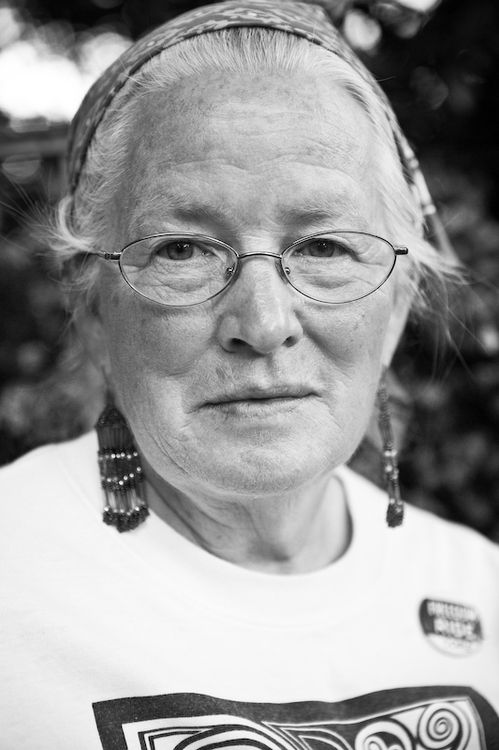
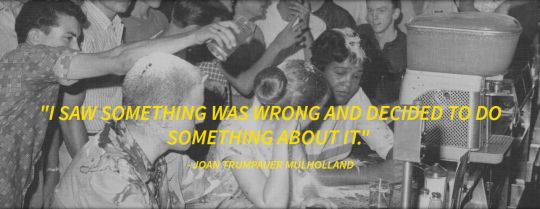
Mugshot of a teenage girl arrested for protesting segregation, Mississippi, 1961.
Her name is Joan Trumpauer Mulholland. Her family disowned her for her activism. After her first arrest, she was tested for mental illness, because Virginia law enforcement couldn’t think of any other reason why a white Virginian girl would want to fight for civil rights.
She also created the Joan Trumpauer Mullholland Foundation. Most recently, she was interviewed on Samatha Bee’s Full Frontal on February 15 for their segment on Black History Month.
Don’t reduce civil rights heroes to “teenage girl”.
Her great-grandparents were slave owners in Georgia, and after the United States Civil War, they became sharecroppers. Trumpauer later recalled an occasion that forever changed her perspective, when visiting her family in Georgia during summer. Joan and her childhood friend Mary, dared each other to walk into “n*gger” town, which was located on the other side of the train tracks. Mulholland stated her eyes were opened by the experience: “No one said anything to me, but the way they shrunk back and became invisible, showed me that they believed that they weren’t as good as me. At the age of 10, Joan Trumpauer began to recognize the economic divide between the races. At that moment she vowed to herself that if she could do anything, to help be a part of the Civil Rights Movement and change the world, she would.
In the spring of 1960, Mulholland participated in her first of many sit-ins. Being a white, southern woman, her civil rights activism was not understood. She was branded as mentally ill and was taken in for testing after her first arrest. Out of fear of shakedowns, Mulholland wore a skirt with a deep, ruffled hem where she would hide paper that she had crumpled until it was soft and then folded neatly. With this paper, Mulholland was able to write a diary about her experiences that still exists today. In this diary, she explains what they were given to eat, and how they sang almost all night long. She even mentioned the segregation in the jail cells and stated, “I think all the girls in here are gems but I feel more in common with the Negro girls & wish I was locked in with them instead of these atheist Yankees.
Soon after Mulholland’s release, Charlayne Hunter-Gault and Hamilton E. Holmes became the first African American students to enroll at the University of Georgia. Mulholland thought, “Now if whites were going to riot when black students were going to white schools, what were they going to do if a white student went to a black school?” She then became the first white student to enroll in Tougaloo College in Jackson, where she met Medgar Evers, Dr. Martin Luther King Jr., Reverend Ed King, and Anne Moody.
She received many letters scolding or threatening her while she was attending Tougaloo. Her parents later tried to reconcile with their daughter, and they tried to bribe her with a trip to Europe. She accepted their offer and went with them during summer vacation. Shortly after they returned, however, she went straight back to Tougaloo College.
She ultimately retired after teaching English as a Second Language for 40 years and started the Joan Trumpauer Mulholland Foundation, dedicated to educating the youth about the Civil Rights Movement and how to become activists in their own communities.
I watched a YouTube video once (by a guy who’s name escapes me) about the importance of making sure the stories of white activists are told. His point was that it’s not about lavishing praise on them just because they were white and “woke”, it’s about letting other white allies see that others have come before them who were willing to sacrifice and do the hard work. This way they can see themselves in someone and realize that destroying inequality isn’t a fringe interest or just an “us vs. them” issue. It has to be ALL OF US.
A Pennsylvania museum has solved the mystery of a Renaissance portrait in an investigation that spans hundreds of years, layers of paint and the murdered daughter of an Italian duke.
Among the works featured in the Carnegie Museum’s exhibit Faked, Forgotten, Found is a portrait of Isabella de’Medici, the spirited favorite daughter of Cosimo de’Medici, the first Grand Duke of Florence, whose face hadn’t seen the light of day in almost 200 years.
Isabella Medici’s strong nose, steely stare and high forehead plucked of hair, as was the fashion in 1570, was hidden beneath layers of paint applied by a Victorian artist to render the work more saleable to a 19th century buyer.
The result was a pretty, bland face with rosy cheeks and gently smiling lips that Louise Lippincott, curator of fine arts at the museum, thought was a possible fake.
Before deciding to deaccession the work, Lippincott brought the painting, which was purportedly of Eleanor of Toledo, a famed beauty and the mother of Isabella de’Medici, to the Pittsburgh museum’s conservator Ellen Baxter to confirm her suspicions.
Baxter was immediately intrigued. The woman’s clothing was spot-on, with its high lace collar and richly patterned bodice, but her face was all wrong, ‘like a Victorian cookie tin box lid,’ Baxter told Carnegie Magazine.
After finding the stamp of Francis Needham on the back of the work, Baxter did some research and found that Needham worked in National Portrait Gallery in London in the mid-1800s transferring paintings from wood panels to canvas mounts.
Paintings on canvas usually have large cracks, but the ones on the Eleanor of Toledo portrait were much smaller than would be expected.
Baxter devised a theory that the work had been transferred from a wood panel onto canvas and then repainted so that the woman’s face was more pleasing to the Victorian art-buyer, some 300 years after it had been painted.
Christ men have been Photoshopping women to make us more “pleasing” since for-fucking-ever.
Also, Isabella de’Medici is nice looking, but also has that look in her eye of all Medicis: “I haven’t yet decided whether I’m going to kick your ass, buy you and everything you own, or have sex with you. Perhaps all three.”
I learned in a history class that because Einstein was an immigrant none
of the US (white) colleges or universities would let him join their
faculty but black colleges and universities welcomed his brilliance with
open arms.
it wasn’t because Einstein was an immigrant, it was because he was Jewish
“Authors can’t use it in fantasy fiction, eh? We’ll see about that…”
–Terry Pratchett, probably
Try to implement anything but a conservative’s sixth grade education level of medieval or Victorian times and you will butt into this. all. the. time.
There was a literaly fad in the 1890′s for nipple rings for all genders(and NO, it was NOT under the mistaken belief that it would help breastfeeding–there’s LOTS of doctors’ writing at the time telling people to STOP and that they thought it would ruin the breast’s ability to breastfeed well, etc). It was straight up because the Victorians were freaks, okay Imagine trying to make a Victorian character with nipple rings. IMAGINE THE ACCUSATIONS OF GROSS HISTORICAL INACCURACY
people just really, REALLY have entrenched ideas of what people in the past were like
tell them the vikings were clean, had a complex democratic legal system, respected women, had freeform rap battles, and had child support payments? theyd call you a liar
tell them that chopsticks became popular in china during the bronze age because street food vendors were all the rage and they wanted to have disposable eating utensils? theyll say youre making that up
tell them native americans had a trade network stretching from canada to peru and built sacred mounds bigger then the pyramids of giza? you are some SJW twisting facts
ancient egypt had circular saws, debt cards, and eye surgery? are you high?
our misconception of medieval peasants being illiterate and living in poverty in one room mud huts being their own creation as part of a century long tax aversion scam? you stole that from the game of thrones reject bin
iron age india had stone telescopes, air conditioning, and the number 0 along with all ‘arabic’ numbers including algebra and calculus? i understand some of those words.
romans had accurate maps detailing vacation travel times along with a star rating for hotels along the way, fast food restaurants, swiss army knives, black soldiers in brittany, traded with china, and that soldiers wrote thank-you notes when their parents sent them underwear in the mail? but they thought the earth was flat!
ancient bronze age mesopotamia had pedantic complaints sent to merchants about crappy goods, comedic performances, and transgender/nobinary representation? what are you smoking?



 tumblr backup