This is the world’s largest flying Engine of Murder marveling at the fact that it can actually have its tummy rubbed.
I feel like this is the next step up on “loose your fingers” roulette from petting a kittie’s tummy, but just below belly rubs for say a lion.
Can someone who knows birds better than I do tell me whether this eagle is as happy as it looks? Because I want it to be happy. It looks so happy. Bewildered by having a friend, but so happy.
Just popping on this thread to confirm: yes, the eagle is happy about the belly rubs. Golden eagles make this sound when receiving allopreening and similar affectionate and soothing treatment from their parents and mates. It’s the “I am safe and well fed, and somebody familiar is taking good care of me” sound. Angry raptors and wounded raptors make some pretty dramatic hisses and shrieks; frightened raptors go dead silent and try to hide if they can, or fluff up big and get loud and in-your-face if hiding isn’t an option. They can easily sever a finger or break the bones of a human hand or wrist, and even with a very thick leather falconer’s gauntlet, I’ve known falconers to leave a mews (hawk house) with graphic punctures THROUGH the gauntlet into the meat of their hands and arms, just from buteos and kestrels way smaller than this eagle. A pissed off hawk will make damn sure you don’t try twice whatever you pulled that pissed her off, even if she’s been human-imprinted.
If you’re ever unsure about an animal’s level of okayness with something that’s happening, there are three spot-check questions you can ask, to common-sense your way through it:
1. Is the animal capable of defending itself or making a threatening or fearful display, or otherwise giving protest, and if so, is it using this ability? (e.g. dog snarling or biting, swan hissing, horse kicking or biting)
2. Does the animal experience an incentive-based relationship with the human? (i.e. does the animal have a reason, in the animal’s frame of reference, for being near this human? e.g. dog sharing companionship / food / shelter, hawk receiving good quality abundant food and shelter and medical care from a falconer)
3. Is the animal a domesticated species, with at least a full century of consistent species cohabitation with humans? (Domesticated animals frequently are conditioned from birth or by selective breeding to be unbothered by human actions that upset their feral nearest relatives.)
In this situation, YES the eagle can self-defend, YES the eagle has incentive to cooperate with and trust the human handler, and NO the eagle is not a domesticated species, meaning we can expect a high level of reactivity to distress, compared to domestic animals: if the eagle was distressed, it would be pretty visible and apparent to the viewer. These aren’t a universally applicable metric, but they’re a good start for mammal and bird interactions.
Pair that with the knowledge that eagles reserve those chirps for calm environments, and you can be pretty secure and comfy in the knowledge that the big honkin’ birb is happy and cozy.
Also, to anybody wondering, falconers are almost single-handedly responsible for the recovery from near-extinction of several raptor species, including and especially peregrine falcons. Most hawks only live with the falconer for a year, and most of that year is spent getting the bird in ideal condition for survival and success as a wild breeding adult. Falconers are extensively trained and dedicated wildlife conservationists, pretty much by definition, especially in the continental USA, and they make up an unspeakably important part of the overall conservation of predatory bird species. Predatory birds are an important part of every ecosystem they inhabit. Just like apiarists and their bees, the relationship between falconer and hawk is one of great benefit to the animal and the ecosystem, in exchange for a huge amount of time, effort, expense, and education on the part of the human, for very little personal benefit to that one human. It’s definitely not exploitation of the bird, and most hawks working with falconers are hawks who absolutely would not have reached adulthood without human help: the sick, the injured, and the “runts” of the nest who don’t receive adequate resources from their own parents. These are, by and large, wonderful people who are in love with the natural world and putting a lifetime of knowledge and sheer exhausting work into conserving it and its winged wonders.
reblogged for excellent info, I’m so glad that big gorgeous birb really is as happy as it looks!
Today’s bit of positive activism: A reminder that, although the world may contain many bad and awful things, it also contains an enormous winged predator clucking happily as a human gives it a belly rub.
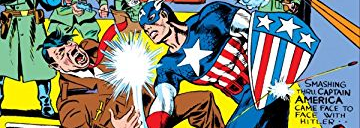
In December of 1940, America still hadn’t entered the war.
There were a lot of Americans – such as the 800,000 paying members of the America First Committee – who looked at fascists massacring their way through Europe and declared “that’s not our problem.”
Captain America was created by two poor Jewish Americans, Joe Simon and Jack Kirby, with the specific intent of trying to convince Americans that entering the war was the right thing to do. It wasn’t easy – Kirby went far beyond what was expected of artists at the time, penciling the entire issue with a deadline that would have been difficult for a two-man crew to pull off.
Captain America punched Hitler right on the cover, at a time when a majority of Americans just didn’t feel like doing anything decisive against the Nazis.
Kirby and Simon faced considerable resistance for their creation, including steady hate mail and outright death threats.
Once, while Jack was in the Timely office, a call came from someone in the lobby. When Kirby answered, the caller threatened Jack with bodily harm if he showed his face. Kirby told the caller he would be right down, but by the time Jack reached street level, there was no one to be found.
Both creators enlisted after America entered the war. Kirby, as an artist, was called upon to do the extremely dangerous work of scouting ahead to draw maps. He also went on to co-create Black Panther in 1966.
They didn’t create Captain America to be an accurate depiction of America-As-It-Is. The character was meant to inspire and embolden, to show America-As-It-Should-Be.
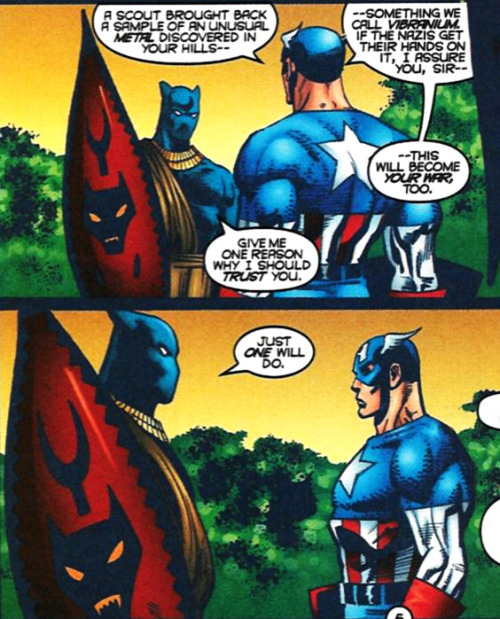
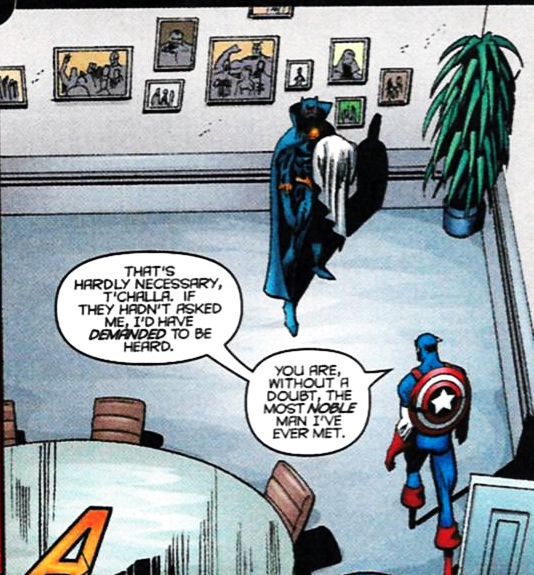
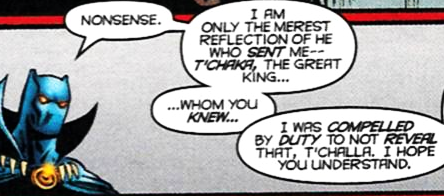
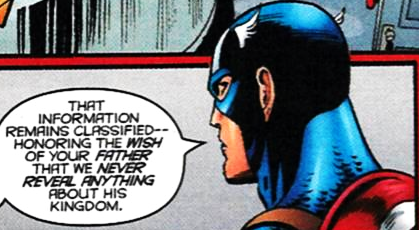
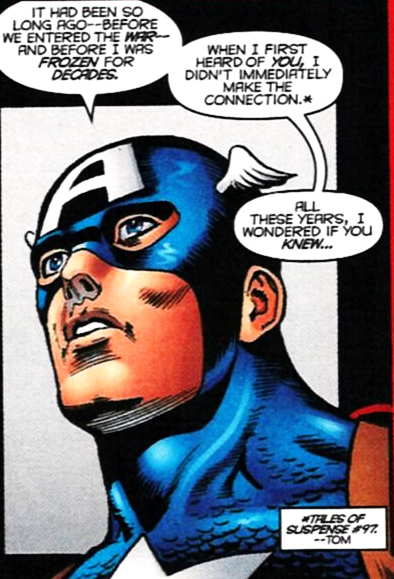
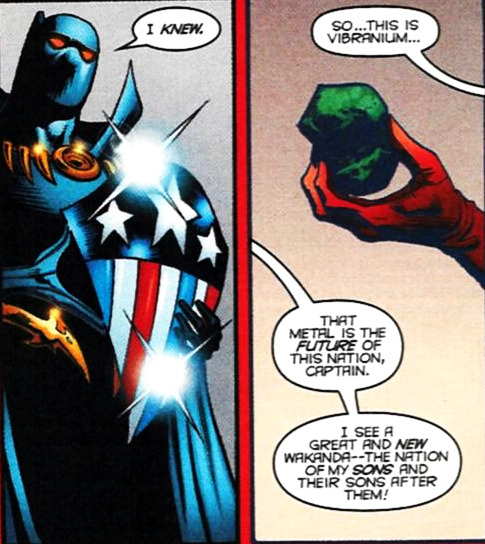
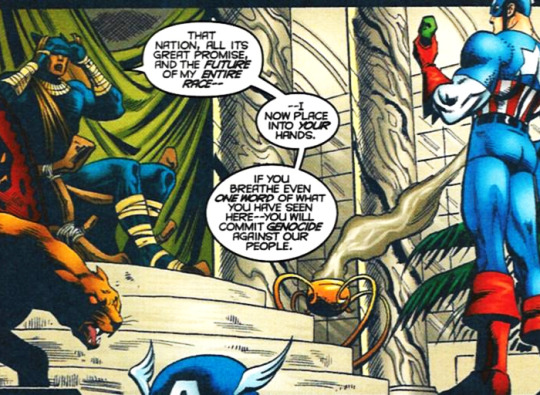
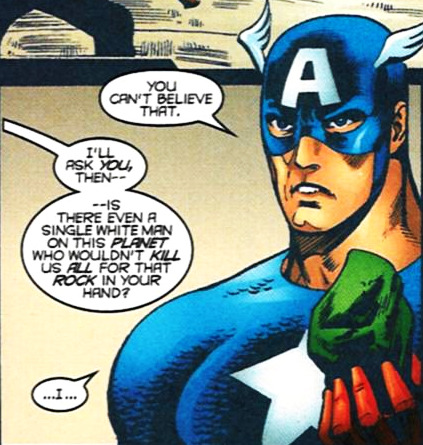
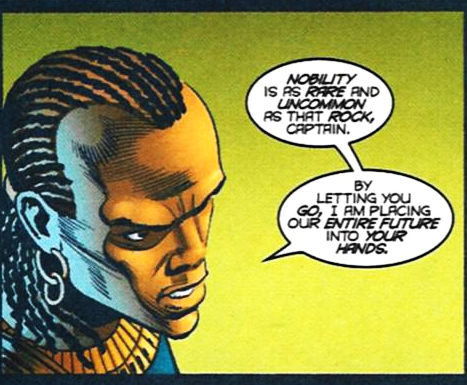
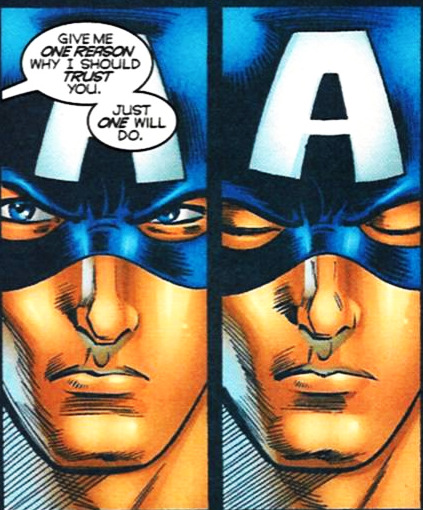
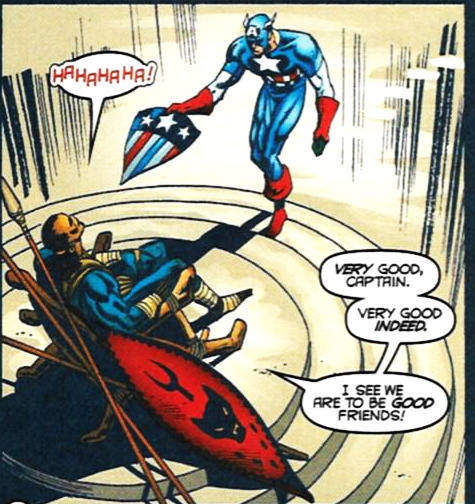
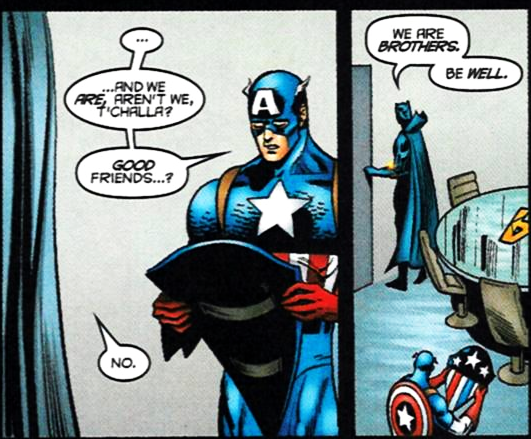
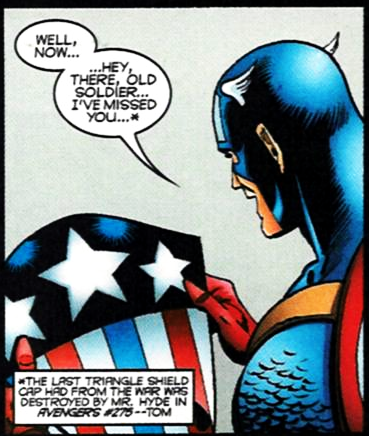
The subject of where the Vibranium for the shield came from actually never came up for decades of comics, until it was finally addressed by Black Panther’s writer, Christopher Priest, in 2001. Priest never shied away from acknowledging America’s racism, but he also understood that Captain America represented an ideal, intended to inspire Americans to be better.
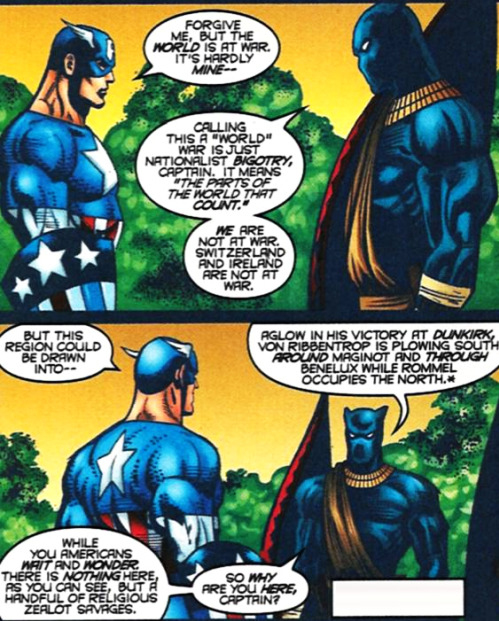
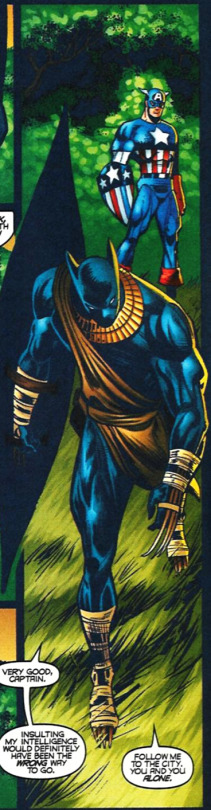
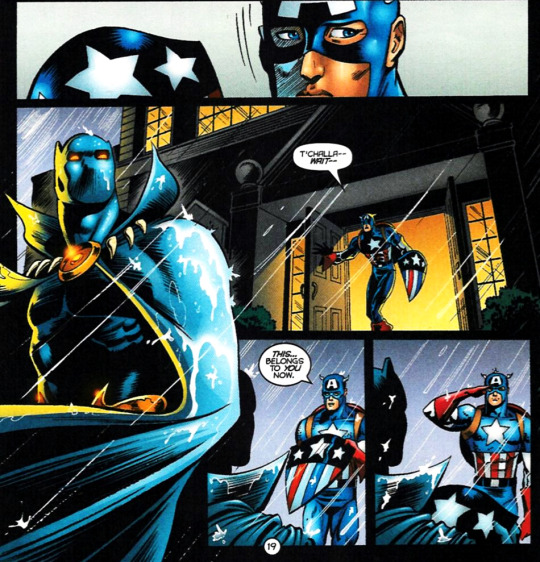
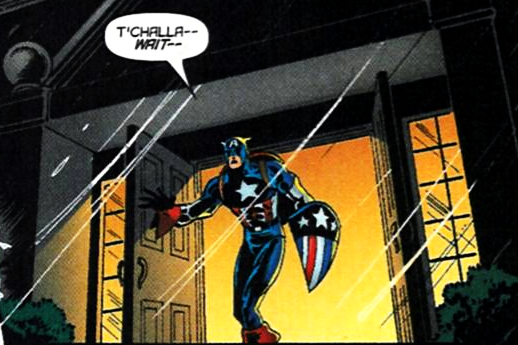
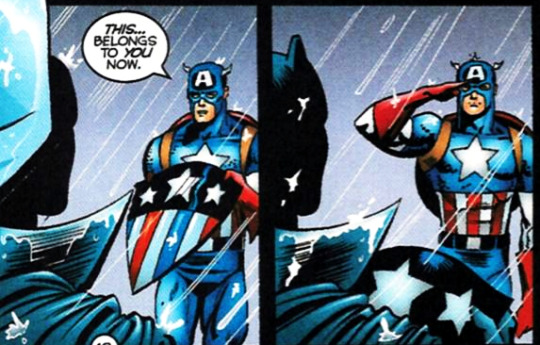
The story mixed together a “present day” discussion between Cap and T’Challa with flashbacks to when Cap met the Black Panther ruling Wakanda during World War II.
FLASHBACK:
PRESENT:
PRESENT -> FLASHBACK
PRESENT:
The Vibranium was given, freely, by one good man to another good man.
It is right to rage against the injustices done by our governments. We must call them out, and we must fight for what’s right.
But if you can’t even stand to see the symbols created to inspire people to be better, and rail against those,then you’re just confusing cynicism for realism.
This was a masterful callout that deserves a place in the callout hall of fame, which I just realized needs to exist. It strikes the perfect tone of, “I’m not criticizing where you’re at on this, I’m holding my hand out and inviting you to step up to the next level in your thinking about it.”
That’s the kind of callout that people can sometimes actually hear, not just for entertaining the bystanders. Truly, we need more of this.