Mad Max Fury Road is full of names: weird, inventive, evocative names. But it also uses them brilliantly. There’s so much information packed into what names are spoken, when and how.
Names and titles are a
classic way of revealing hierarchy. Joe is named repeatedly, and each time it
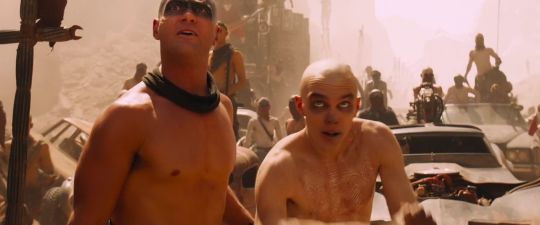
shows his relationship with the person naming him. Nux’s “Immortan! Immortan
Joe!” is all about his godlike status. The Organic Mechanic’s “Joe” is deliberately
casual, not actively disrespectful but certainly not worshipful.
Then there’s
the ongoing tension in what Joe calls Angharad: “Splendid” most of the time,
reverting to her proper name at moments of stress, when he really needs her to
listen. In the canyon scene, he goes from “Splendid, that’s my child, my property” when he’s trying to rebuke her to “Angharad! Get out!” when he realises she’s at risk of hitting the rock. It’s implied that she rejects “Splendid” – certainly the other wives
only ever call her Angharad. (More generally, the wives use each other’s names simply, to get each other’s attention: I don’t get any sense of hierarchy from it.)
On screen, Furiosa explicitly uses names to form connections. When she asks for
Max’s name, it’s a deliberate attempt to achieve emotional engagement, because
she needs him on side. And it’s rare for her: not only does she not name the wives, she doesn’t use the war rig crew’s names,
either. In a movie that keeps its dialogue sparse, every word counts – and every omitted word counts, too.
Within the Citadel hierarchy,
war boys don’t get named by anyone but each other. “I’ve got a war boy, running
on empty,” says the Organic Mechanic. An imperator later uses exactly the
same phrasing to introduce Nux to Joe: “I’ve got a war boy, says he
was on the war rig”. It suggests that, from the top of the Citadel hierarchy,
war boys are seen as interchangeable.
One describes Nux as if he were a machine; the other – “says he was on the war rig” – implies his lower status, framing his evidence as hearsay.
It’s clearly a huge honour for Joe to ask
Nux his name. It’s also the only time we see a Citadel full-life acknowledge a
war boy’s name.
War boys in this film
are both abusers and victims – terribly fragile, desperate for attention from
the powerful class that exploits and uses them, not questioning its
values. They go unnamed by their superiors, but they name each other as
often as possible: “Morsov!” “Slit, what’s happening?” Though Nux shouts “Crew,
out of the way!” at Ace – maybe they don’t know names beyond their own crews,
or maybe he just doesn’t recognise Ace from behind.
They use names to
encourage each other. Just look at the way they all shout Morsov’s name before
witnessing him. “Witness me” is a plea for affirmation: see what I’m
doing, make it mean something. Witnessing is an act of performative masculinity – I liked @bookishandi‘s post on witnessing Nux’s death. But it’s also framed as an act of mutual support
(which I think is why it’s taken off so much in fandom). Morsov’s death – which is really the viewer’s
introduction to “witnessing” as a concept – is part of a scene that shows
us the war rig crew working smoothly together.
The exception is Slit,
who tries to undermine his colleagues instead, shouting “Mediocre,
Morsov!” rather than “witness”, or telling Nux that Joe wasn’t looking at
him, “He was scanning the horizon”. And of course Slit is the most
insecure of the lot, begging for any scrap of attention: “I got the
blood bag’s boot! Take me, I got his boot!”
Imperators, and others
from the Citadel’s powerful classes, are clearly known by their names. “Furiosa,
she took a lot of stuff from Immortan Joe”, for instance. There’s no sense that
war boys give this recognition to anyone not at the top of that hierarchy. The war boy who
tells Nux about Furiosa talks about the wives as things
– “stuff”, “prize breeders”. Nux’s own reaction to the wives
– “so shiny, so chrome” – sees them as objects rather than people. And of
course he goes on calling Max “blood bag”, even when he thinks they’re on
the same side. It’s not a conscoius insult; it clearly doesn’t occur to him that Max
might mind – any more than Nux minded the way the Organic Mechanic or the imperator talked about him.
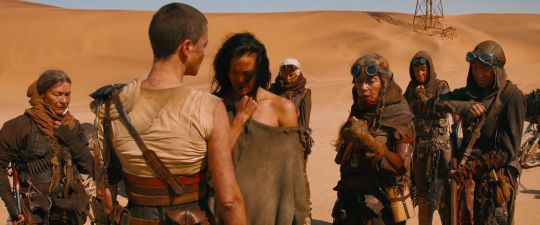
Then there’s the scene when Furiosa greets the Vuvalini. Here’s what she says:
“I am one of the Vuvalini, the Many
Mothers. My initiate mother was K.T. Concannon. I am the daughter of Mary
Jobassa. My clan was Swaddle Dog.”
This is a speech proving her identity, but how she does it is so revealing. She doesn’t
use her own name at all. Instead, it’s all about a web of relationships, of
connections, the ways in which she belongs. (She’s also proving that she belongs by demonstrating knowledge of Vuvalini society.) She lists her initiate mother
before her birth mother – her place in the community before her lineage. Her
tenses are interesting, too. Her clan was
Swaddle Dog – she’s left, the clan may no longer exist, she’s talking about the
past. But when she talks about being Vuvalini, it’s “I am”. Even though she’s asking for recognition, it
has none of the war boys’ neediness – she’s naming what she is, how she chooses
to see herself. She’s not seeking approval or affirmation.
And though the
Vuvalini team work is smooth, they do it without shouting
names – to the point where most of the Vuvalini characters don’t have names at
all (which is very unhelpful for fandom, George). Citadel naming is intensely
hierarchical, about who does, and doesn’t, get respect. Vuvalini naming is
about community, identities built up through choices and relationships.
Of course, the film’s most powerful naming scene has nothing to do with the Citadel or the Vuvalini: it’s Max telling Furiosa his name. (OH MY HEART.) It’s the conclusion of Max’s emotional arc, his return to being a human being: accepting a name, accepting his own identity. Crucially, he accepts it by sharing it. Throughout the film, names are meaningful because they’re how people connect with each other. In the “My name is Max” scene, we see Max choosing to do that. Engage to heal.

 tumblr backup